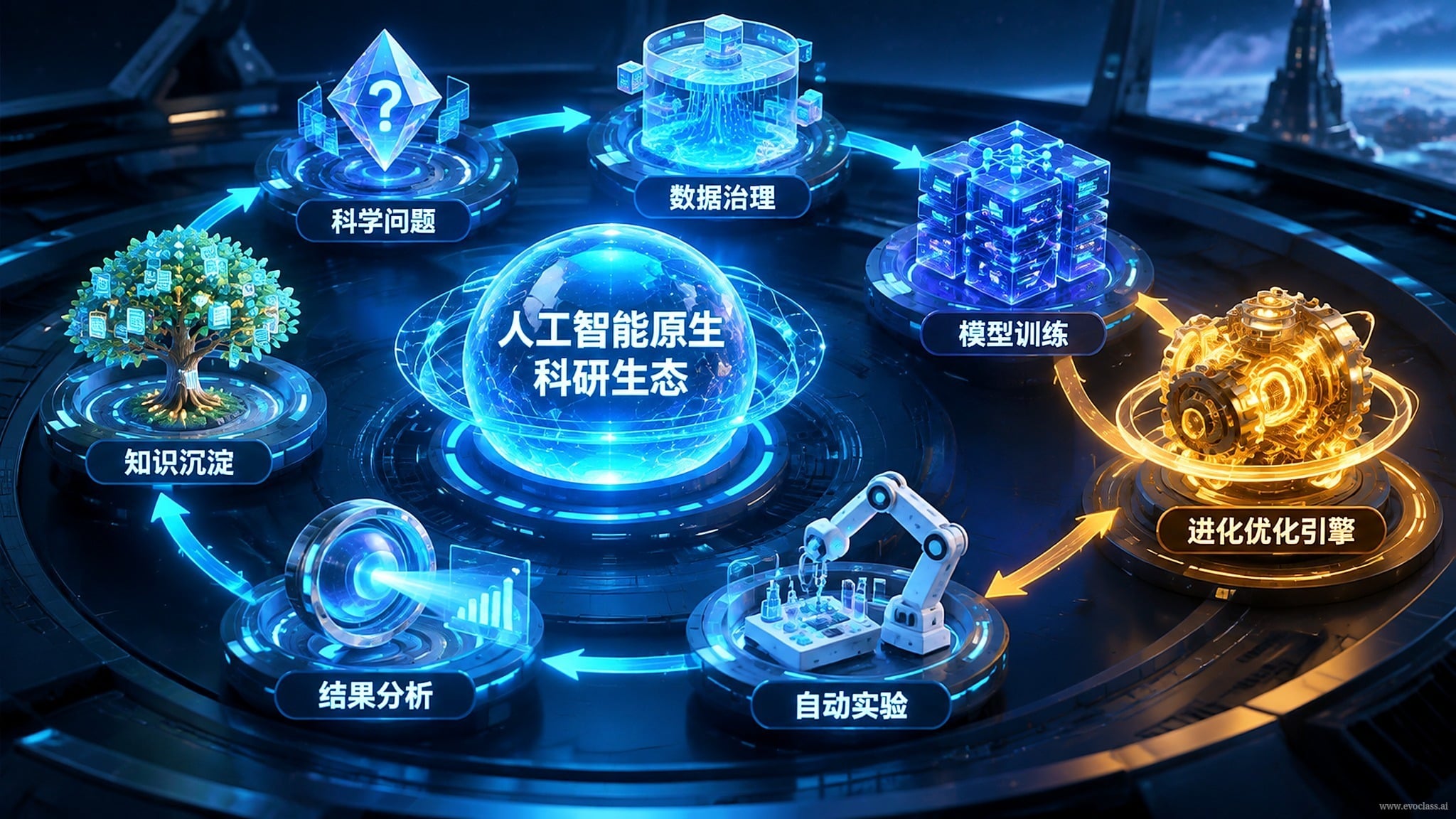
As the cost of code generation and implementation drops rapidly, the research bottleneck is shifting from"Can we build it?"to"Is it worth doing, and are we doing it right?".The AI Native research paradigmtreats large models, GPUs, agents, and automated workflows as the default research infrastructure. A researcher's core responsibility likewise shifts from personally writing implementation code to asking questions, defining evaluations, judging direction, and critically assessing results.
Paradigm Shift: Redrawing the Human-AI Division of Labor on Top of Default Infrastructure
When the cost of implementation approaches zero, "writing a few more versions and running a few more rounds" becomes cheap in itself. What is truly scarce ischoosing which direction to explore, and before the results,staying criticalThe division of labor is thus redrawn: AI handles implementing answers, accelerating experiments, and broadening the search; humans handle steering direction, constraints, taste, and key decisions. This is not about outsourcing judgment as well, but about moving human attention up from "typing code" to "setting standards, making trade-offs, and reading results."
EvoX: An Intelligent Evolution System, Not a Single-Algorithm Tool
EvoX inherits the technical lineage of evolutionary computation, targeting complex multi-objective problems, open-ended exploration, and system-level continuous evolution. It offers not just a solver, but anrunnable, composable, sustainably explorableengineering foundation: the artifacts of one experiment can be inherited by the next, and the search process itself can keep evolving.
- Problem Definition: identify the objective conflicts and constraints in real problems, rather than picking an algorithm first.
- Evaluation Design: write clearly what "good" means — metrics, weights, and acceptance thresholds.
- Evolution Process: AI generates candidate solutions in batches, rapidly iterates code, and runs and compares them in parallel.
- Runtime Scheduling: manage compute, concurrency, and runtime state so exploration stays sustainable and reproducible.
Hands-On Entry Path: From "Choosing an Algorithm" to "Designing a Process"
A typical misconception is treating the entry point as "picking one from a set of algorithms." The AI Native approach is to first identify objective conflicts and constraints, then turn the problem into an exploration process EvoX can execute: humans first define the objective conflicts, constraints, and acceptance criteria; then AI rapidly generates and iterates code; EvoX runs candidates in batches and compares them; and finally, critiquable, verifiable results emerge. For example, in a multi-objective optimization experiment, you don't let AI write all the code and then take the output at face value — machines handle implementation and exploration, while humans handle definition and judgment.
AI Native Research Division-of-Labor ArchitectureThe macro architecture diagram shows the division of labor in the AI Native research ecosystem: large models, GPUs, agents, and automated workflows serve as default infrastructure; AI handles implementation, accelerating experiments, and broadening the search; researchers handle problem definition, evaluation design, direction trade-offs, and critical assessment of results. As the engineering foundation, EvoX supports batch runs, candidate comparison, and makes experimental results inheritable and the process sustainably evolvable.